

By Joseph Lento
On the Nature of Tests and Grades
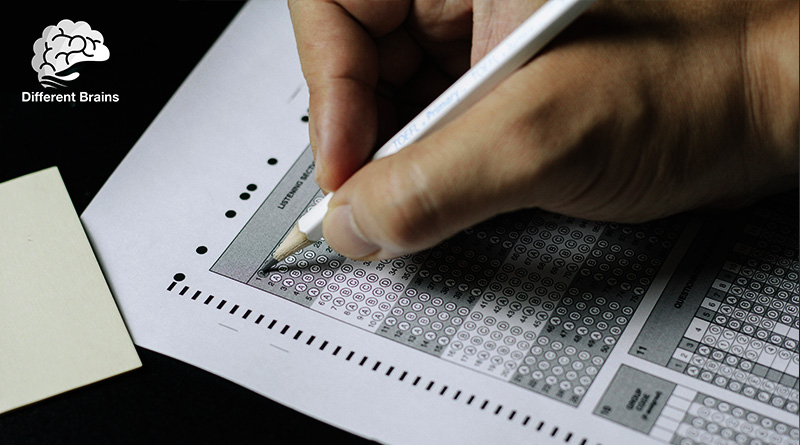
When we stop and examine tests, tests we’ve all taken in school, the vast majority were Multiple Choice and True/False. That means that we had the Answers to every Question right in front of us. We were never expected to know the answers but be proficient in recognizing them. What does that speak to as a societal expectation about Critical Thinking and Concrete Knowledge? Not much I’m afraid, not much. So why then do we put so much stock into those who memorize better than those who don’t? Why not simply give everyone a book with all the correct answers from the beginning and stop wasting time spreading the belief that we are teaching for Concrete Learning, which is having the knowledge because you own it through Critical thought? It would sure save a lot of time and money, right? You can muse on that while I modulate into the Grading System
All of us live in a Grading System of Anticipated Fear. You know, it’s almost identical to Medical Tests. Even the most routine annual bloodwork, or as we get older, preventive examinations of our organs and bones causes fear. We are all anxious about the results, but there is a significant difference between the results we anxiously await from our teachers and those from our Physicians, and that is accuracy. Of course, there can be a rare lab error or miscalibration of an X-Ray etc. but with medical tests we are not punished when we have something wrong with us. We are treated specifically for the ailment. We are not punished for having it. Certainly, we are not punished with the alteration of the results of the tests we took because we didn’t take them when our doctor advised us to, but in education students are punished every day for turning in work after the Due Date. Even if the student’s work is perfect, they are punished with a reduction in their grade, simply because it was not done ‘on time.’

Let’s look at my juxtaposition of medical test results and school test results a bit more. Let’s pretend that you have a nasty cold and you wait to have your annual bloodwork done until after it subsides. When your cold subsides, you go to have your blood drawn for your annual examination. Fortunately it turns out to be normal, but your physician decides that you didn’t go when you were supposed to, so they will now alter your results as a form of punishment and put you on medications you don’t need. Or even worse, imagine that your cholesterol turned out to be high, and your doctor (in order to ‘show you’ to take your blood test when you were told to) denies you the medicine you need.
What if you had family in from out of town, or were going through a personal relationship issue, or you lost your job, or any other number of things that happen to people. So you were two weeks late for your in office annual physical and the doctor didn’t want to hear any excuses as to the reason you were late. It’s his practice and you cannot disrespect him (like it or not all too many teachers take students turning in work late as a personal affront) and now your blood pressure reading will be skewed, your Oxygen finger test will be skewed, and the examination of your Heart, Lungs and Abdomen by their Stethoscope will be skewed. That will teach you to never again be late to his office! Do you see the connection to the “grading systems” in our schools? If a doctor did those things, what would happen to that doctor? So then, why are we paying high taxes and high tuition fees for schools that will intentionally misdiagnose students’ work?
Carrot, Stick, or Diagnostic Tool?
Now before you get your Britches in a tussle or your Knickers in a twist, I never said that students’ work should not be turned in on time, but what does that mean? Are we concerned with a timetable or an outcome? Please spare me the “they must learn to be on time with things because the ‘real world’ won’t let them ‘get away’ with turning in their work late”. The ‘Real World’ wants its work done correctly, which means being late with the final product is not important. Accuracy is important, but not as much in our schools, at least compared to speed, for some reason. Do I understand that certain things must be done on time? Of course I do, but if that’s your only take away then you are missing the larger and more important point. Just as physicians are charged with observing and documenting an accurate picture of our health, so too are Schools charged with observing and documenting an accurate picture of student knowledge. Keep in mind that most subjects are overarching, and while it’s advantageous to follow a course chronologically or developmentally, that is simply not always possible and skewing a student’s work is unethical.
I know all the counter arguments, and they are almost always centered on the school and a teacher’s policies, which should always stand for accuracy and not represent a fragile ego. Children are not disrespecting you or the education (get ready for this) they are paying you to give them. There are a few reasons students do not hand in work on time and here is the order:
- They do not understand the work at that moment
- They are not feeling well
- They are working long hours after school
- They have emotional issues dealing with family etc.
Number one on that list aggravates schools more than anything else and I’ve heard it. “If they hand in the work late that means they are cheating”. Possibly, but what does “cheating’ in this instance mean? It means that because of numbers 2, 3 and 4 they are getting the work from someone else because on their own at that moment, they cannot do it. However, it mostly points to the fact that someone else is teaching them, and it’s usually a friend or parent because the teacher cannot reach them.
The Danger of Zero
Giving a ‘Zero’ for work that was never done is tantamount to falsifying medical records, and in my opinion that person should have extensive retraining. Imagine if your doctor took your Heart rate three weeks after your originally scheduled appointment and wrote down Zero Beats. Do you see the point? Do you see the intensely negative impact that inaccurate grading has on the ethical and empirical expectations of our schools and educators? It’s long overdue that grading systems reflect actual work and let the students and their families figure out the other things. Remember, there is no Hero in Zero!